
What Are My Options if Most of My Teeth Are Broken?
in Phoenix, AZ
You have two main paths. The first is to save what can be saved: broken teeth are rebuilt one by one with fillings, root canals, and crowns, and the unsavable ones are replaced individually. The second is to stop repairing and rebuild the whole arch on implants, with options like All-on-4 replacing every tooth in a jaw at once. Which path is right depends on how many teeth are genuinely savable, what each path costs over ten years rather than one, and what you want your daily life to look like, and an honest office will show you both before recommending either. The fork gets decided with an exam, a 3D image, and a written plan for each path. Dr. Taylor Field does exactly that at Sonoran Dental Arts in Phoenix. Call (602) 861-0505.
If most of your teeth are broken, worn to stumps, or crumbling, you already know something is wrong; what you probably do not know is where to even start, and the fear of hearing it is often what has kept you away. So here is the start, in plain terms: your situation has two main paths, both of them well traveled, and neither of them begins with judgment about how you got here.
Dr. Taylor Field plans both paths at Sonoran Dental Arts in Phoenix, and sees mouths like yours regularly, whatever your mirror has been telling you.
See Both Paths Before Choosing Either
One exam produces a tooth-by-tooth verdict and, where it is a close call, a written plan for each path with every step and fee named. You choose with the whole picture in hand, and nothing starts before your yes.
Get an Appointment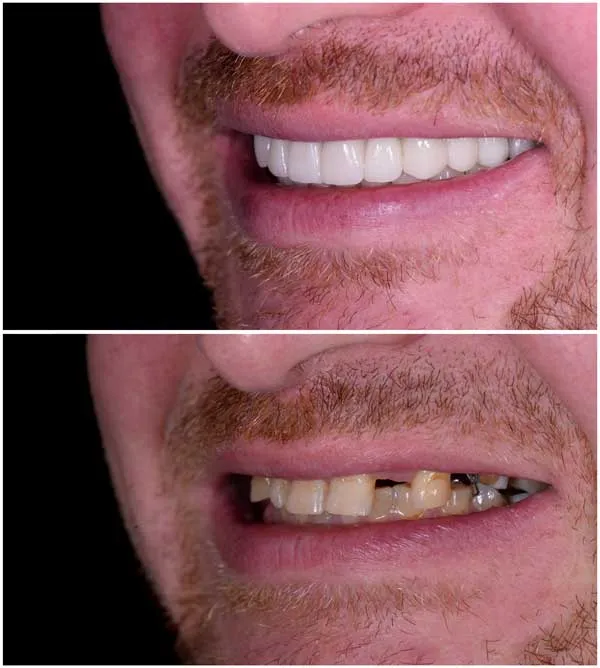
First, What Broken Actually Means
Broken covers a wide range, and the range is the whole decision. A tooth broken at the gum line with a healthy root can often carry a post and crown. A tooth with deep decay but a live nerve may need only a large filling or a root canal and crown. A tooth cracked through the root, or loose from gum disease, usually cannot be saved by anything. A mouth where most teeth are broken is almost always a mix of these, which is why no honest answer exists until each tooth has been looked at individually, on an X-ray, by someone who will tell you the truth per tooth.
Path One: Save What Can Be Saved
This is the tooth-by-tooth rebuild: root canals and crowns for the savable, extractions and individual implants or bridges for the rest, staged over months in order of urgency. Its strengths are real: you keep your own roots where they are healthy, which is always the best version of a tooth, and the work can be phased to spread the cost. Its weakness is also real: when too many teeth are borderline, you can spend crown-level money on teeth that fail anyway a few years later. This whole-mouth version of the rebuild is called full mouth reconstruction, and it has its own page covering how the staging works.
Path Two: Replace the Arch
When most teeth in a jaw are failing, there is a point where repairing them one by one stops making sense, and the alternative is to remove what is left and rebuild the whole arch on implants: a fixed bridge carried by four or more posts, as on the All-on-4 page, or other full-arch designs compared on the full-mouth dental implants page. Its strength is finality: one plan, one predictable result, no more watching borderline teeth fail one at a time. Its cost is just as plain: it means giving up every tooth in that arch, including any good ones, which is why this path should never be the first suggestion for a mouth with plenty worth saving.
How the Fork Actually Gets Decided
Three questions settle most cases. How many teeth are truly savable, counted one by one on the X-rays rather than estimated across the room? What does each path cost over ten years, because a cheap-looking repair path that needs redoing is not cheap? And what do you want your life to look like, since some people want to fight for every tooth and others want to stop thinking about their teeth entirely? Both answers are legitimate. A close call should produce two written plans, one per path, so you can compare them line by line at your kitchen table instead of deciding in the chair.
Be Careful With One-Answer Offices
A broken-down mouth is valuable to the wrong kind of clinic, because the full-arch path is the expensive one and some offices sell it to everyone who walks in. The test is simple: an office that only ever recommends removing everything, without a tooth-by-tooth verdict on paper, is selling a product rather than planning your mouth. Before agreeing to have teeth removed, especially all of them, read the page on what to ask before having all your teeth removed; it exists for exactly this moment.
What the Numbers Look Like
Honestly: a mouth-wide plan is a significant investment on either path, and the only meaningful number is the written estimate built from your own X-rays. What is published: the per-implant fee of $2,000–$2,400 and the extraction fee of $240–$340, with the full pricing anatomy on the dental implant cost page and the arch-level picture on the All-on-4 cost page. Treatment on either path can be phased, HSA and FSA funds apply, and the plan names every stage and fee before anything begins.
How It Works at Sonoran Dental Arts
Dr. Field examines every tooth, takes the 3D image, and gives you the tooth-by-tooth verdict first: savable, borderline, gone. Then the fork gets discussed with both paths on the table, and you take the written plan, or both plans, home to decide at your own pace. Nothing starts before you have agreed to it, and no one here will shame you for how your mouth got to this point.
Helpful Links
Common questions
Do all my broken teeth have to come out?
Not necessarily, and that should never be assumed from across the room. Broken ranges from a crown-ready root to a cracked, unsavable one, and most broken-down mouths are a mix. The tooth-by-tooth verdict on X-rays comes first; the big decision comes after.
Is it better to save broken teeth or replace them all with implants?
It depends on how many are genuinely savable and what each path costs over ten years, not one. Healthy roots are worth keeping; a mouth full of borderline teeth can make the arch rebuild the saner spend. A close call deserves a written plan for each path so you can compare them side by side.
What does it cost to fix a mouth full of broken teeth?
There is no honest single number; it is a written estimate built from your own X-rays. The published anchors are $2,000–$2,400 per implant and $240–$340 per extraction, the cost pages explain what else goes into the total, and either path can be phased so the plan follows your budget.
Can broken teeth be fixed in stages?
Yes, and for the save-what-saves path staging is normal: urgent and infected teeth first, then chewing function, then the cosmetic finish. A written staged plan means each visit builds toward the finished mouth instead of patching at random.
I'm embarrassed by how bad my teeth are. Will I be judged?
Not here. Mouths like yours walk into this office regularly, and the exam is about what happens next, never about how you got here. The first visit is a look and a conversation; nothing is done to you that day, and nothing ever starts before you have agreed to it in writing.
How do I avoid being sold a full-arch treatment I don't need?
Ask for the tooth-by-tooth verdict in writing before any arch-level recommendation, and be wary of an office whose answer is always removal. A second opinion is cheap insurance before anything irreversible; the page on what to ask before having all your teeth removed lists the exact questions.
Visit Us in Phoenix
Neighborhoods We Serve Near Phoenix, AZ 85020
Your Local Dentist
Patients visit us from neighborhoods across North Central Phoenix, including Squaw Peak, Biltmore Greens, and Dreamy Draw Homes, thanks to our convenient location near Glendale Ave and 16th Street. We are located near Glendale Avenue and 16th Street in the heart of North Central Phoenix, Sonoran Dental Arts proudly serves a wide range of surrounding communities. Whether you’re in the Biltmore area or tucked near the trails of Piestewa Peak, we’re your trusted neighborhood dental provider. Our patients come from:
- Squaw Peak
- Squaw Peak Foothills
- Biltmore Highlands
- Dreamy Draw Homes
- Canterra at Squaw Peak Condominiums
- Lincoln Vista
- Desierto Sierra
- The Pointe
- Biltmore Vista
- Biltmore Greens
- Biltmore Courts
- Biltmore Colony
- Biltmore Villas
- Arizona Biltmore Estates
- Granada Park
- Lincoln Vistas
- Madison Village
- Estate Monterra
- Rolling Hills Estates
- Tonka Vista
- Hopi Vista
- Patio Del Sol
- Torre Blanca
- Royal Crest Villa
- Ocotillo Manor
- Gatewood Manor
- East Orangewood
- Orangewood Heights
- New NorthTown
- Navea Ventura
- La Mirada Condominiums
- Madison Meadows
- Luci’s at the Orchard Area
- Arizona Sunburst Inn vicinity
- Madison Rose Lane Area
- Bethany Estates
- Piestewa Peak Neighborhood
- The Pointe at Squaw Peak Resort Area
- Holy Trinity Greek Orthodox Area
- Sprouts Farmers Market Neighborhood (Glendale & 16th)
If you’re located in or near any of these neighborhoods, Dr. Taylor Field and the Sonoran Dental Arts team are here to provide top-quality, patient-centered dental care close to home. Explore our General Dentistry, Family Dentistry, Kids Dentistry, Cosmetic Dentistry, Dental Implant Services, Invisalign, and Emergency Dental Care to see how we can serve you.
Life in North Central Phoenix is full. Work commutes. Weekend hikes. Quick dinners with friends. When you’re balancing all that, your smile should be the last thing holding you back. That’s where dental implants come in. They restore confidence. They keep life moving—whether you’re near Squaw Peak, Dreamy Draw, or grabbing coffee by Luci’s at the Orchard.
In the Squaw Peak Foothills and Dreamy Draw Homes, mornings often start outdoors. The trails are busy, the sun comes up fast, and neighbors are out early. Missing teeth or a loose denture can make those moments feel smaller than they should. Dental implants bring stability back. You laugh without worry. You share a trail snack or coffee and feel like yourself again.
The Biltmore neighborhoods have their own rhythm. Biltmore Highlands, Arizona Biltmore Estates, Biltmore Greens, Biltmore Vista—here life is busy and polished. Business lunches at the Biltmore, family nights out, evenings with friends. Implants fit naturally into this lifestyle because they look and function like real teeth. You don’t think about them. You just live.
Closer to Granada Park or Madison Meadows, afternoons mean school pickups, sports practices, and grocery stops. Families move quickly. Nobody wants dental care that slows everything down. With implants, you can eat the meals you want, smile without hesitation, and get back to what matters. No adhesives. No slipping. Just strong, reliable teeth.
Evenings near Lincoln Vista, Tonka Vista, and Rolling Hills Estates are for winding down. Neighbors chat. Kids ride bikes. Dinner happens at home or a favorite local spot. For many, enjoying those meals fully wasn’t always possible. Implants change that. Steak, crunchy veggies, fresh bread—they’re all back on the table. Life tastes better again.
Weekends at The Pointe Resort or gatherings near Canterra at Squaw Peak Condominiums bring people together. It’s laughter in photos. It’s toasts at celebrations. It’s casual moments that deserve a confident smile. Implants give you that. They don’t come out. They don’t shift. They’re built to last.
This community is close-knit. From East Orangewood to Navea Ventura, from Torre Blanca to Patio Del Sol, people share recommendations. A dental office earns trust when care feels personal. Dental implants are more than a procedure—they’re a step toward comfort, security, and enjoying life in the neighborhoods you love.
Living near Piestewa Peak or the Glendale and 16th Street corridor means convenience matters. You want treatment that’s close to home, not across town. Implants make long-term dental health simple. They protect your jaw, preserve your smile, and free you from constant repairs.
If you’re in Squaw Peak, Dreamy Draw, the Biltmore communities, or any of the neighborhoods nearby, know that implants are an option designed for real life here. Strong. Natural. Lasting. A solution that fits where you live, eat, play, and connect. That’s how dental implants help you keep pace with Phoenix—and enjoy every part of it.